Your Home Humidity Levels (and How to Reduce Them)
If your home feels sticky in the summer or overly dry in the winter, your indoor humidity may be out of balance. Humidity control is not just about comfort. It directly affects your heating and air conditioning performance, indoor air quality, and even the condition of your home. In this guide, our HVAC professionals explain what the ideal home humidity level should be and what to do if your system is not maintaining it properly.
So… What is Humidity?
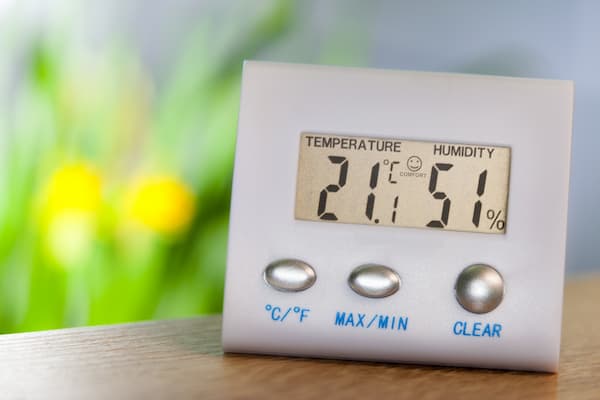
Before we can figure out the perfect humidity for your home, let’s ask a quick question: what exactly is humidity?
You might have a rough idea that humidity is the amount of water in the air, and you’d technically be correct! However, it’s a little more complex than just that. To understand what humidity is, we need to talk about the difference between relative humidity and absolute humidity.
Absolute Humidity
“Absolute humidity” is the mass (mass = how much) of water in the air, divided by the mass of air that is in a given space. Absolute humidity is an equation that looks at the literal amount of mass that moisture has in the air around you. Absolute humidity is expressed as grams of moisture per cubic meter of air (g/m³).
Relative Humidity
“Relative humidity” is the humidity reading that you are probably more familiar with. To find out the ideal home humidity for yourself, this is also the measurement we are going to use. While absolute humidity measures the amount of water vapor in the air, relative humidity measures the current level of moisture in the air out of how moist the air could be.
So, when you see your humidity reading at 40%, it simply means that the air around you is 40% as moist as it could be.
Humidity and Feeling Comfortable
Do you know why humans naturally feel so uncomfortable in really humid climates? Your skin uses the air around it to get rid of moisture on your body. So, when the humidity level is near 100%, the air cannot absorb the moisture on your body, namely sweat.
Sweat is your body’s natural air conditioner. When you sweat, your body attempts to maintain its ideal temperature (98.6). When you can’t get rid of that extra moisture and cool yourself off, it’s much harder to feel comfortable.

Finding the Ideal Humidity Level in a House
So now that we’ve talked about comfort levels, you can probably guess what we’ll say next. The ideal humidity level for your home is going to be relative to you and your family. It will depend mostly on the time of year, what kind of clothes you’re wearing, and where your family is naturally comfortable.
Research shows that the ideal relative humidity for your home is between 40%-60%. However, to discourage the growth and spread of mold, levels should be kept below 50%. But, again, adjust this to match your comfort levels. This relative humidity in your home should also scale with the outdoor absolute humidity.
As you probably know, absolute humidity levels change along with the temperature and seasons. In the summer, the air contains more moisture, and in the winter, it contains much less moisture.
- For an outdoor temperature over 50˚F, indoor humidity levels shouldn’t exceed 50%
- With an outdoor temperature over 20˚F, indoor humidity levels shouldn’t exceed 40%
- Outdoor temperature between 10˚F and 20˚F, indoor humidity levels shouldn’t exceed 35%
- For an outdoor temperature between 0˚F and 10˚F, indoor humidity levels shouldn’t exceed 30%
- Outdoor temperature between -10˚F and 0˚F, indoor humidity levels shouldn’t exceed 25%
- With an outdoor temperature between -20˚F and -10˚F, indoor humidity levels shouldn’t exceed 20%
- Outdoor temperature at -20˚F or lower, indoor humidity levels shouldn’t exceed 15%
So, you will need to adjust your humidity levels as the year goes on. But what happens when you don’t have your humidity at the ideal level?
Issues with Low Humidity
- Itchy or dry skin
- More vulnerable to cold and infection
- Damage to wood furniture and hardwood floors
- Respiratory conditions may worsen, as dry air aggravates the airways.
- Increased virus survival rates, suggesting a higher risk of infections in drier environments.
Issues with High Humidity
Likewise, when the humidity is too high in your home, you’re probably going to notice the effects.
- High humidity promotes the growth and spread of mold
- Those who suffer from asthma and allergies may experience worsened symptoms
- Trouble sleeping in uncomfortable conditions
- Moisture problems in your home – You might notice condensation on your windows. This excessive moisture can cause damage to your furniture and fixtures.
HVAC Solutions for Controlling Humidity in Your Home
Many humidity problems inside a home are directly related to HVAC performance. Air conditioning systems, ventilation, and dedicated humidity control equipment all work together to maintain healthy indoor air quality.
If your home struggles with humidity, several HVAC solutions may help:
Whole-Home Humidifier Installation
During the winter months, heating systems can dry indoor air significantly. Installing a whole-home humidifier adds controlled moisture to the air and helps maintain comfortable humidity levels throughout your home.
Whole-Home Dehumidifier Installation
In the summer, excessive humidity can make your home feel warmer and less comfortable. Whole-home dehumidifiers remove excess moisture and help your air conditioner work more efficiently.
Air Conditioning System Performance
Air conditioners naturally remove moisture from indoor air. If your AC system is improperly sized or not operating efficiently, it may fail to control humidity properly.
Indoor Air Quality Improvements
Ventilation upgrades, air purification systems, and airflow improvements can also play a role in balancing humidity and improving indoor comfort.
If your home constantly feels too humid or too dry, the HVAC professionals at Laury Heating Cooling & Plumbing can inspect your system and recommend the best solution.
Humidity Challenges in South Jersey Homes
Homes throughout South Jersey experience major humidity swings during the year. Summers often bring heavy moisture levels that can make homes feel sticky and uncomfortable, while winter heating systems can dry indoor air to uncomfortable levels. At Laury Heating Cooling & Plumbing, we regularly help homeowners in Vineland, Millville, Washington Township, and surrounding communities balance indoor humidity through properly designed HVAC systems and whole-home humidity control equipment.
Our team understands how local climate conditions affect comfort, air quality, and energy efficiency.
How to Achieve the Ideal Home Humidity Level
So now that we know what can go wrong, what can we do to make things go right? Well, here’s the first step. If you don’t have one, installing a humidifier is going to be extremely beneficial in the winter months.
Remember that in the summertime the air will naturally be humid, so you can safely store away the humidifier for those dry winter months. Keeping your home at the perfect humidity level is going to do wonders for your family’s comfort. Consequently, keeping an ideal home humidity level is also crucial to the health of your home and its structure.
It’s true! Your indoor air quality directly affects your family’s health and also the health of your home. From exacerbating existing skin and asthmatic conditions to deteriorating wooden upholstery and furniture, indoor air quality plays a huge role in your home comfort.
At Laury Heating Cooling & Plumbing, we help homeowners control humidity through HVAC adjustments and installation of whole-home humidifiers and dehumifiers. If your home feels too dry or too humid, our technicians can evaluate your system and recommend the right solution.
To learn more about improving the air in your home, you can also read our guide on preventing indoor air poluttion!